The Story of Architect Klodiana (Emiri) Taçi
From 20 Years at DEA Studio to a New Chapter with MA Studio & Partners Architecture as passion, artistic creation, and a responsibility for improving quality of life.
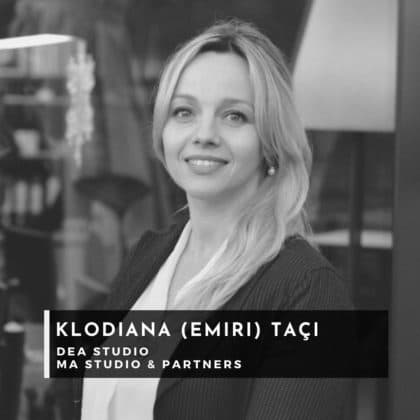
You are probably familiar with DEA Studio, a name that became part of Albania’s architectural and design landscape over the course of two decades. Behind that story are the people who built it, project by project, idea by idea. One of them is architect Klodiana (Emiri) Taçi, co-director of DEA Studio for 20 years and today one of the leading figures behind MA Studio & Partners. Her journey is not simply the story of moving from one studio to another. It is the story of a professional philosophy that has evolved alongside architecture, the city, and the way we live. Architecture, More Than a Profession For Klodiana, architecture has always been more than a profession. It is a passion. And it is a passion precisely because, at its core, architecture is an act of artistic creation. Yet architectural creativity cannot be separated from function. A building must be both beautiful and liveable, rational and emotional, technical and human. As Klodiana explains: “Architecture is a synthesis of function and aesthetics. Functional interpretation, the harmonisation of spaces and the aesthetic dimension together form the essence of how a building is experienced and are the key to the success of every architectural creation.” From this perspective, aesthetics is not a layer added to architecture at the end of the process. It develops together with function. The organisation of spaces, the relationships between them, light, materiality, proportion, and the way people move through a building all come together to shape the architectural experience. Architecture as Quality of Life There is another important dimension to Klodiana’s philosophy: responsibility. Architecture directly influences the way we live. The home where we wake up. The office where we work. The street we walk along. The school where we learn. The park where we spend our time. The public spaces where we encounter one another. An architect, therefore, does not simply design square metres. An architect designs part of people’s everyday lives. “Architecture has a mission to directly improve the quality of life, both in public and private spaces,” Klodiana says. This idea places people at the centre of the design process. The success of a project is not measured solely by the image it creates, but by the way it functions and is experienced over time. 20 Years with DEA Studio For two decades, Klodiana was part of the leadership and development of DEA Studio. It was an intensive period of creativity and professional experience, shaped through projects of different scales, functions, and characters. Every project presented a new problem to solve. Every client introduced a different way of thinking. Every site offered a new context to interpret. Over the years, this experience created not only a portfolio of projects but also a particular way of thinking about architecture. Because twenty years of practice changes the way an architect sees space. Experience teaches you when to intervene and when to exercise restraint; when form should speak and when it should give way to function, context, or materiality. Above all, experience creates the foundation from which to pursue the next challenge. MA Studio & Partners: A New Chapter After a 20-year journey with DEA Studio, Klodiana entered a new professional chapter with MA Studio & Partners. A new identity, built upon an extensive legacy of architectural experience. MA Studio & Partners represents an opportunity to take a philosophy consolidated over many years and move it forward, while confronting the new questions facing contemporary architecture. Because architecture today faces very different challenges from those of two decades ago. Cities are becoming denser. Ways of living are changing. Technology is transforming how we design and experience buildings. At the same time, climate change and the use of natural resources demand a fundamental reconsideration of how we build. The Challenge of Sustainable Architecture It is here that Klodiana sees one of the most compelling directions for the next phase of her work: sustainable architecture. Today, it is no longer enough for a building to function well and possess a strong aesthetic identity. We must also consider the energy it consumes, the materials it uses, its orientation, its relationship with climate, its lifespan, and its environmental impact. Energy efficiency therefore becomes an integral part of the architectural concept itself. It should not be treated merely as a technical requirement to be resolved after the architecture has already been designed. Building orientation, natural light, ventilation, shading, insulation, materials, and technological systems must all be considered as part of a unified architectural strategy. For Klodiana, this represents not only a necessity but one of the most fascinating fields shaping the future of architecture. Aesthetics + Function + Sustainability If architecture has traditionally sought a balance between function and aesthetics, contemporary architecture must introduce a third dimension: sustainability. This creates a new equation for the architect: Function + Aesthetics + Environmental Responsibility. The challenge is not to treat these elements separately, but to integrate them into a single, coherent architectural language. A building can be energy-efficient without losing its character. It can embrace technology without losing its human dimension. It can be aesthetically compelling without becoming disconnected from reality. And it can be contemporary while remaining deeply respectful of the place in which it stands. Designing for the Future After more than two decades in the profession, the story of Klodiana (Emiri) Taçi is not simply one of looking back. It is a story that looks forward. From her 20-year experience with DEA Studio to the new chapter of MA Studio & Partners, one conviction remains constant: architecture must create value beyond the physical object. The buildings we design today will continue to influence people’s lives for decades to come. And for precisely this reason, architecture requires more than creativity. It requires responsibility. It requires research. It requires evolution. And above all, it requires passion. For Klodiana (Emiri) Taçi, architecture remains exactly that: the art of bringing together function and aesthetics, people and space, and the present with the way we aspire to live in the future.