
Open Lecture at Epoka University of Architect Ervin Taci: Designing the Context
Within the framework of ARCH 505 – Special Topics in Architectural Design, architect Ervin Taçi delivered an open lecture titled “Designing the Context” at EPOKA University, sharing with architecture students insights drawn from professional practice, international experience and the realities they will encounter beyond university.
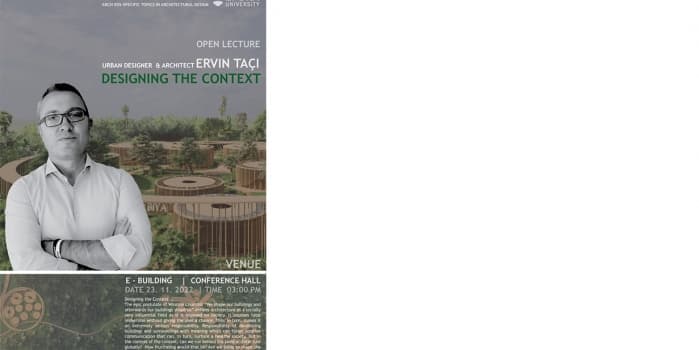
Open Lecture at Epoka University of Architect Ervin Taci: Designing the Context Designing the Context Ervin Taçi Open Lecture at EPOKA University Architecture begins with context — but designing within context requires understanding far more than the physical conditions of a site. Within the framework of ARCH 505 – Special Topics in Architectural Design, architect Ervin Taçi delivered an open lecture titled “Designing the Context” at EPOKA University, sharing with architecture students insights drawn from professional practice, international experience and the realities they will encounter beyond university. The lecture created a bridge between architectural education and professional life, exploring one of the most fundamental questions in contemporary practice: How should architects respond when designing within different physical, social and cultural contexts? From Architectural Education to Professional Practice Architecture school teaches students how to observe, research, conceptualise and design. Professional practice introduces another layer of complexity. The architect must learn to negotiate between ideas and reality — between design ambition, the client, the site, regulations, budgets, construction methods and the cultural environment in which a project will ultimately exist. A central aim of Ervin Taçi’s lecture was therefore to share fragments of professional life that students will encounter once they graduate. Rather than presenting architecture exclusively through completed buildings and polished images, “Designing the Context” offered a perspective on the thinking, decisions and challenges behind the architectural process. It is in this transition from concept to reality that the architect’s role becomes particularly complex. What Does It Mean to Design the Context? Every architectural project begins somewhere. A site. A city. A landscape. A climate. A community. But context is not simply the physical location surrounding a building. It is also history, culture, behaviour, materials, climate, economic conditions and the ways in which people understand and inhabit space. To design within context therefore requires more than responding to dimensions, orientation or topography. It requires observation and interpretation. The architect must first understand a place before attempting to transform it. This idea formed the conceptual foundation of Taçi’s lecture. Context should not be treated as a limitation to creativity. It can become the generator of architecture itself. Designing Across Cultures One of the central case studies presented during the lecture explored a project developed in Africa, offering students an opportunity to examine the challenges of designing outside the architect’s familiar cultural environment. Working in another country inevitably changes the architectural process. Assumptions that may appear natural within one cultural context can become irrelevant in another. Climate changes. Materials change. Construction traditions change. Social relationships with space change. Even fundamental concepts such as privacy, community, circulation and the relationship between indoor and outdoor environments can carry different meanings. The challenge for the architect is therefore not to arrive with a predetermined architectural language and impose it upon the site. The challenge is to listen to the context first. From Observation to Design Strategy Designing in an unfamiliar environment requires curiosity. Before drawing, there must be research. Before form, there must be understanding. Through the African project presented during the lecture, Taçi introduced students to innovative design strategies developed in response to a different cultural and environmental reality. The project demonstrated how architecture can emerge through an interpretation of local conditions rather than through the repetition of familiar solutions. Culture becomes design information. Climate becomes design information. Local patterns of living become design information. Materials and construction knowledge become design information. The architect’s task is to bring these elements together and transform them into a coherent spatial strategy. In this sense, designing the context does not mean reproducing the context. It means understanding its underlying logic and using that knowledge to create something contemporary, relevant and specific to its place. Architecture Between the Local and the Global The discussion also raises a wider question facing contemporary architecture. Today, architects increasingly operate internationally. Projects cross borders. Studios collaborate across countries. Images, technologies and architectural references circulate globally almost instantaneously. Yet architecture ultimately remains physical. Every building belongs somewhere. This creates an important tension between global architectural knowledge and local identity. An architect may bring international experience, technological knowledge and new design methodologies to a project, but these must ultimately enter into dialogue with the specific conditions of the place. The objective is not necessarily to choose between global and local. It is to discover how the two can inform one another. The Albanian Context The lecture also opened a conversation about professional practice closer to home. Students had the opportunity to ask Ervin Taçi questions about his experience working within the Albanian architectural context, connecting the theoretical discussion to the realities of architecture in Albania. For young architects preparing to enter the profession, this dialogue is particularly important. The transition from university to practice introduces questions that cannot always be answered within the design studio alone. How does an architect defend an idea? How does the original concept survive the development process? How do you respond to constraints without losing architectural quality? How do you work with clients, engineers and other disciplines? And how does an architect develop a personal position while continuously responding to changing contexts? There are rarely universal answers. Professional experience is built precisely through confronting these questions repeatedly. Architecture as a Continuous Learning Process One of the most valuable lessons behind “Designing the Context” is that architectural education does not end with graduation. If anything, graduation marks the beginning of another form of education. Every new project teaches the architect something. A new site introduces different constraints. A new client introduces another perspective. A different country challenges established assumptions. An unfamiliar culture requires new ways of observing. Professional practice therefore becomes a continuous process of learning, questioning and adapting. For an architect, experience should not eliminate curiosity. It should deepen it. Connecting Practice and the Next Generation Open lectures such as this one create an important connection between professional practice and architectural education. Students gain access not only to projects, but to the experiences behind them — including uncertainties, decisions, constraints and lessons that rarely appear in the final photographs of a building. For practicing architects, these encounters are equally valuable. The questions of students can challenge established assumptions and reopen conversations about the fundamentals of architecture. In this way, architectural knowledge becomes something that is continuously exchanged rather than simply transferred from one generation to another. Designing Begins with Understanding The central message behind Ervin Taçi’s “Designing the Context” extends far beyond a single lecture or project. Architecture does not begin with form. It begins with observation. With understanding the site. Understanding the climate. Understanding culture. Understanding people. And understanding the complex relationships that already exist before the architect arrives. Only then can design become meaningful. Because the most relevant architecture does not simply occupy a place. It understands where it belongs — and transforms that understanding into space.